
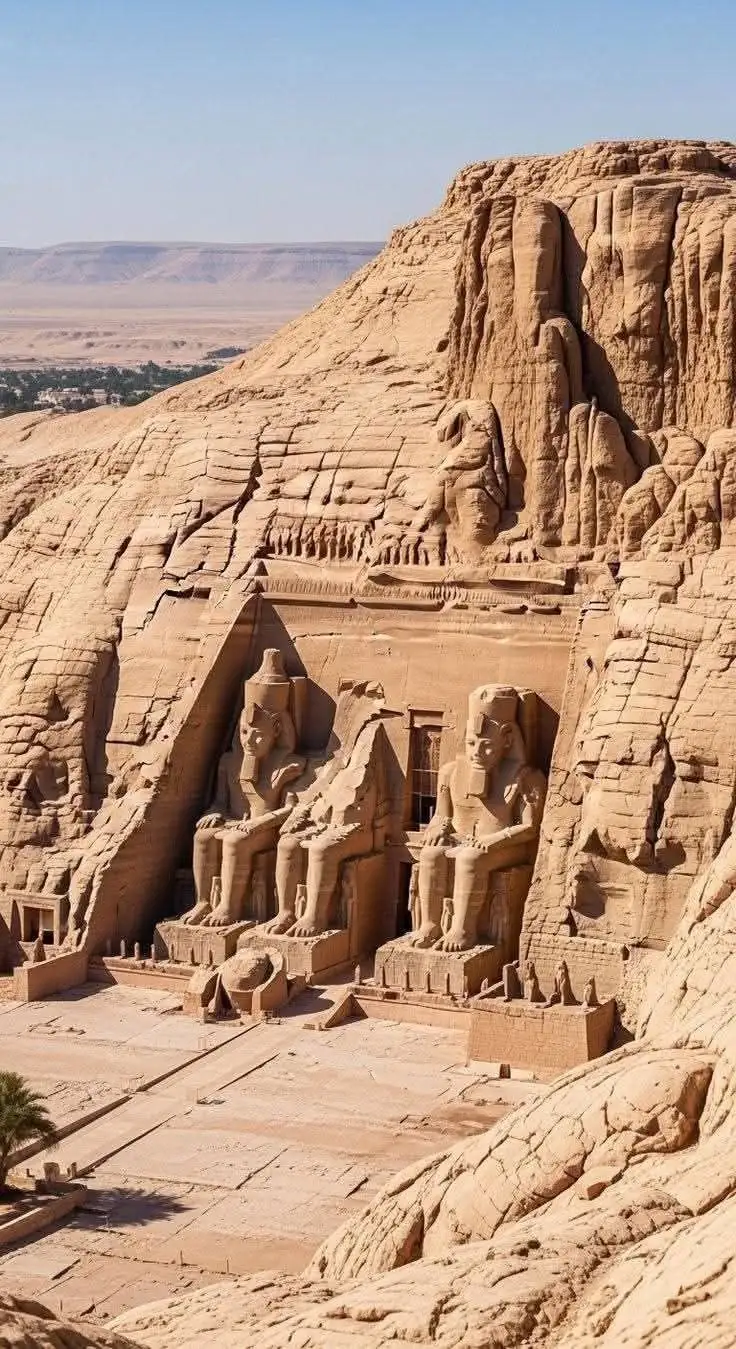
The Abu Simbel Sun Festival: When the Sun Lights the Pharaoh's Face
The Abu Simbel Sun Festival falls on 22 February and 22 October each year, when the rising sun sends a shaft of light 60 metres into the mountain and lights three of the four statues in the temple's inner sanctuary — Ramesses II, Ra-Horakhty and Amun. The fourth, Ptah, a god associated with darkness, deliberately stays in shadow. The event is brief and the sanctuary is small and fills fast, so the morning is built around an early start south from Aswan and being in position before the light moves. The temple was moved in the 1960s to save it from Lake Nasser and the alignment still works, shifted by about a day. Aswan is most comfortable from October to April, which makes 22 October the easier of the two dates.
Deep in ancient Nubia, Ramesses II carved a temple into a mountainside more than 3,000 years ago, and aligned it so precisely with the sun that twice each year its innermost sanctuary lights up. It is one of the most astonishing feats of ancient African engineering you can witness in person — and unlike almost everything else in Egypt, it happens on a schedule.
What happens at the Abu Simbel Sun Festival, and when
On February 22 and October 22 each year, the rising sun sends a shaft of light 60 metres into the mountain, through the great hall to the sanctuary at the very back. There it illuminates three of the four seated statues: Ramesses II, Ra-Horakhty and Amun. The fourth, Ptah, a god associated with the underworld and darkness, remains in shadow, exactly as the builders intended.
The whole event is brief. The sun rises, the light travels the length of the hall, the sanctuary brightens, and it passes. That is why the day is organised entirely around being inside at the right minute rather than around a long visit.
Why Ptah stays in the dark
This is the detail that turns a light show into an argument about ancient engineering. Three gods are lit and one is not, and the one left out is the god associated with the underworld and with darkness. The alignment does not merely admit sunlight into a room — it selects which figures the sunlight reaches and leaves a specific one out, in a chamber cut 60 metres into solid rock.
The two dates are traditionally linked to Ramesses II himself. What makes the temple remarkable is the precision behind that: builders in ancient Nubia and Egypt understood the sun's path well enough to engineer the effect into a mountain, and get it right twice a year, for over three thousand years.
What moving the temple did to the alignment
In the 1960s the temple was moved to save it from the rising waters of Lake Nasser, when the High Dam flooded much of Nubia. The entire mountainside was cut apart and rebuilt on higher ground — and the engineers worked hard to preserve the alignment.
They very nearly did. The effect still happens today, just a day or so shifted from where the original builders put it. It is worth holding both facts at once when you stand there: the alignment is ancient, and the fact that you can still see it is modern.
What the morning actually looks like
The festival draws crowds, and the sanctuary at the back of the temple is small. It fills quickly. That combination is the whole logistical problem of the day, and it has one solution: arrive before dawn, and be inside and positioned before the light starts moving.
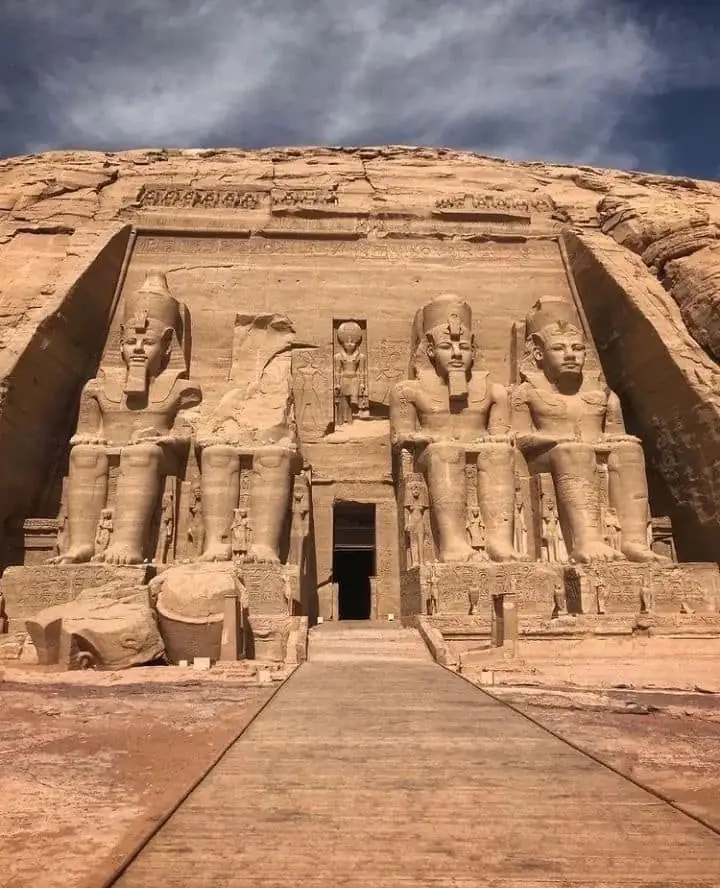
You start early, south from Aswan, in the dark. The temple opens onto the water of Lake Nasser, and the first thing you see is the four colossi of Ramesses at the entrance, which is worth the early start on its own. Then you go in and wait.
What else you see at Abu Simbel
Beside the great temple stands a second one, built for Ramesses' queen Nefertari — her own temple, at her own scale, next to his. Most visitors are so focused on the colossi that they give it a few minutes; it deserves more.
And there is the setting. Abu Simbel sits deep in what was ancient Nubia, in the heart of the land of Kush. This is the borderland where Egypt and Kush spent centuries entangled, and where the story eventually turned: around 730 BC the Kushite king Piye marched north and took the double crown, founding the dynasty of the Black pharaohs. If you are travelling for the heritage rather than the monuments, Abu Simbel is not a side trip. It is the destination.
How to be there for the alignment
The dates are fixed, which cuts both ways: you can plan years ahead, and so can everybody else. Hotels in Aswan fill for both dates, so this is one to arrange early rather than to decide on in the month before.
Every journey we run is private and tailor-made — tell us you want to be inside the sanctuary on 22 February or 22 October and we will build the itinerary around that morning, rather than fitting the date into a fixed departure. It pairs naturally with the rest of the Nubian south: the island Temple of Philae, the Nubian Museum in Aswan, and an afternoon in a living Nubian village.
Which of our journeys reach Abu Simbel
Abu Simbel is on the itinerary of several of our private trips, so the alignment can be built into any of them:
- Cairo, Luxor & Aswan Nile Cruise — 5 days, from $780 USD
- African American Group Tour: Egypt & Nubia Heritage Journey — 8 days, from $1,390 USD
- HBCU & Divine Nine Egypt Tour — 8 days, from $1,390 USD
- Black Girls' Trip to Egypt — 8 days, from $1,390 USD
- Kemet & the Black Pharaohs: A Nubian Heritage Journey — 8 days, from $1,460 USD
- Short Dahabiya Escape, Luxor to Aswan — 6 days, from $1,920 USD
If you cannot make the dates
Go anyway. The alignment is two mornings a year; the temple is extraordinary on the other 363. The colossi, Nefertari's temple and the sheer audacity of the thing being carved into a mountain and then moved by crane do not depend on the sun reaching the back wall.
Aswan is at its best from October to April, when the days are warm rather than fierce — which is also why 22 October tends to be the more comfortable of the two dates. Learn more about Nubia, the ancient Black kingdom, or read our guide to the best time to visit Egypt.
Want to build a trip around the Sun Festival?
See our Nubian heritage journeyFrequently Asked Questions
When is the Abu Simbel Sun Festival?
It happens twice a year, on February 22 and October 22, when the rising sun illuminates the temple's inner sanctuary.
Which statues are lit up?
The sunlight illuminates Ramesses II, Ra-Horakhty and Amun. The fourth statue, Ptah, a god linked to darkness, deliberately stays in shadow.
Why is one statue left in shadow?
Ptah is associated with the underworld and with darkness, and the alignment leaves him out on purpose. That selectivity — three gods lit, one not, in a chamber cut 60 metres into rock — is what makes the engineering remarkable rather than merely impressive.
Do I need to arrive early?
Yes. The effect happens at sunrise and the sanctuary is small and crowded, so you arrive before dawn after an early start south from Aswan. It is best done on a guided visit that gets your group positioned before the light starts moving.
Did moving the temple change the alignment?
Slightly. The temple was moved in the 1960s to save it from the rising waters of Lake Nasser, and the engineers worked hard to preserve the effect. It still happens, just a day or so shifted from where the original builders put it.
How long does the illumination last?
It is brief. The sun rises, the light travels the length of the great hall, the sanctuary brightens, and it passes — which is why the morning is organised around being in position rather than around a long visit.
Can I visit Abu Simbel outside the festival dates?
Yes, and it is worth it. The alignment is two mornings a year; the colossi, Nefertari's temple beside them and the scale of the whole thing are extraordinary on the other 363 days. Aswan is most comfortable from October to April.
Cite this page
Mohammed Hossam (2026). “The Abu Simbel Sun Festival: When the Sun Lights the Pharaoh's Face”. Egypt Top Light Travel. https://egypttoplight.net/blog/abu-simbel-sun-festival-guide, updated 4 August 2026.
You are welcome to quote or reference this page. A link back to the source is appreciated.